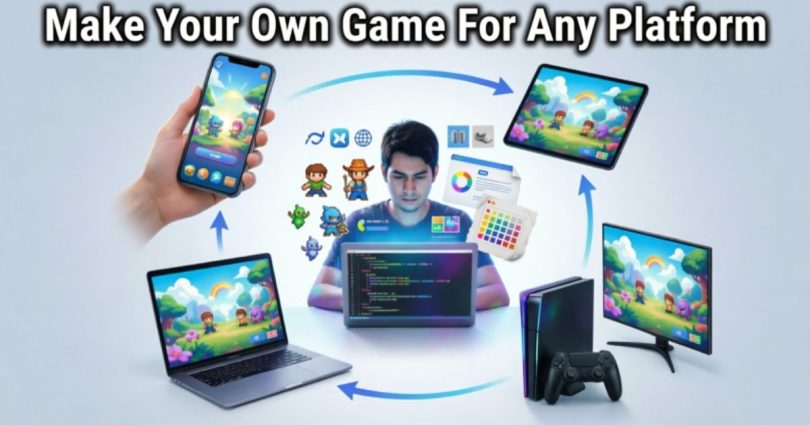

Play your own game; you can also create one using no-code tools that enable you to make games without writing code. And these are very visual tools, and they let you do things like drag and drop, and use pre-packaged assets, to make a game.
Create dashing campaigns, puzzles, and races -or scientific fun, as you’re not the only one who’s been intimidated by coding. The rise of no-code game platforms smashes that barrier and lets amateur game makers be. Just use some imagination and passion, and you can start from a blank slate to make a game.
The rise in interest in no-code game-making is because it’s time-efficient as well as fun. Consoles like the Astrocade enable artists to think and dream without struggling with technical challenges. So, if you’re a student, an entrepreneur, a teacher, or even just a gaming fan, no-code platforms represent the easiest way to become the next big game developer.
Easy Game Creation
That straightforward approach allows beginners to make designs from the very start. Rather than earning their technical chops by taking months trying to become video game developers, they’re developing levels, designing characters, and building fun gameplay experiences. Most no-code apps have a tutorial that guides you step by step.
The democratization brought about by these platforms fosters game development as a truly everyone-can-do-it art form. Students may design educational games for use in class projects. Small business owners can make promotional games to advertise their businesses. Hobbyists can turn their ideas into playable adventures without hiring developers and - in some cases – programmers.
Creative Design Freedom
Video game developers can change the character, environment, sounds, and game mechanics. But all of those have big asset stores filled with pre-made art, animations, and effects. These are the types of programs that, if you can make anything in the arts at all, can enable you to create games without needing art skills.
Developers can make changes on the fly and get immediate feedback: Storytelling is taken care of by the freedom to build. For amateur developers, this freedom is almost mind-boggling,| paramount. Indie developers can now concentrate on making unique titles that get lost in an ever-busier market rather than building massive development teams. That means more brand·new, uniquely personal games every year than ever before.
Faster Development Process
Conventional game development can be a very lengthy process. Programming, testing, bug fixing, and asset creation often take months or years of work. Development time is greatly reduced on no-code platforms, as many of these activities are simplified. Ready-made templates are one of the main reasons development is faster.
Game creators can choose from templates for various types of games instead of starting from a blank slate. These templates serve as the basis for user modification. Preloaded features also help save precious time.
Valuable Learning Experience
Game creators should understand how gameplay mechanics affect player engagement. They learn how level design affects both difficulty and fun. They also get to peek into storytelling, visual design, and user experience. These are just some of the skills you’ll need to make great games, with or without technical knowledge, and they can be learned in your spare time with a bit of patience and effort.
The need to apply lessons learned immediately makes hands-on education so effective. Rather than just reading about theory, developers get to see the consequences of their design choices in actual gameplay, looking at the end-user side of their game. This real-world practice consolidates meaningful lessons and builds confidence.
Simple Game Publishing
The way you make games is now completely different with the advent of no-code game creation systems. What once required years of programming knowledge can now be accomplished with a visual, intuitive software that uses drag-and-drop elements. These products make it possible for hobbyists, students, small businesses, and the creatively minded to turn their ideas into a reality quickly and easily.
Like children taught concepts in degrees, like through a game such as ABC, game developers are also educated in degrees, crafting enticing game methodologies. All you need is a little imagination, a bit of know-how, and a handful of solid tools, and virtually anyone can make games to share with players across the globe.
Conclusion
How you go about making your own games has been permanently changed by no-code game creation systems. What once took years for software developers to build can now be accomplished through visual, intuitive software with drag-and-drop elements. These are allowing amateurs, students, startups, and creatives to bring their ideas to life quickly and easily.
If you’re interested in making your own game, no-code tools are definitely the best, easiest way to get started right now. Like children imbibing ideas bit by bit via a game like Elastic Thief 2, game designers are too schooled in levels, crafting compelling game plans. With a little imagination, some know-how, and a few good tools, almost anyone can make games to play with people around the world.”
FAQs
What are no-code game platforms?
No-code game platforms are software tools that help users create games using visual interfaces. They eliminate the need for traditional programming skills.
Is it free to make your own game?
Many no-code platforms offer free plans with basic features. Premium plans are available for advanced tools and publishing options.
Is It Possible for a Newbie to Make a Game of Their Own?
Yes – even beginners have the chance to make great games with no-code tools. Most platforms offer tutorials and templates to guide the user through the process.
How long does it take to make a game?
You can develop a game in as little as a couple of days if you’re making something simple, or in a couple of weeks or more if you’re making an involved game.
Can I distribute a game made with no-code software?
Yes. Many no-code platforms allow you to package games for websites, mobile devices, and other digital platforms.